Implied Volatility Charts for Options
The volatility side of your book, charted: what implied volatility did to each position you actually hold, weighted the way your vega feels it.
Implied volatility, per position you hold.
A chain-wide volatility number tells you about the market. It does not tell you what happened to your position, which lives on particular strikes and particular expiries with particular vega. IV Charts records implied volatility per contract you hold, over a lookback you choose, across every connected brokerage.
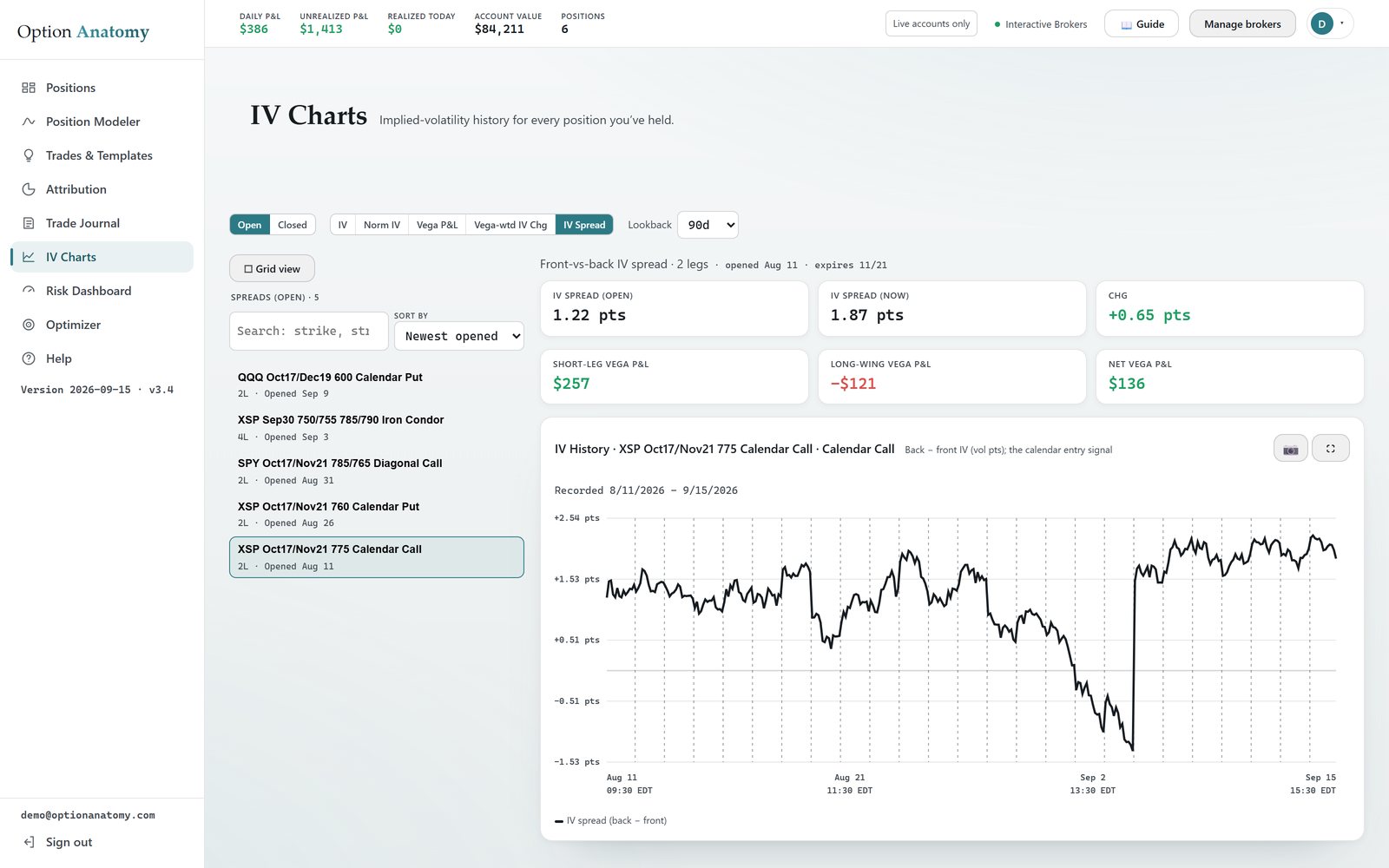
The IV spread between legs is charted alongside, because that spread is what a calendar or a diagonal actually trades. A tent bleeding while spot sits still is usually a spread story, and this is where it becomes visible instead of mysterious.
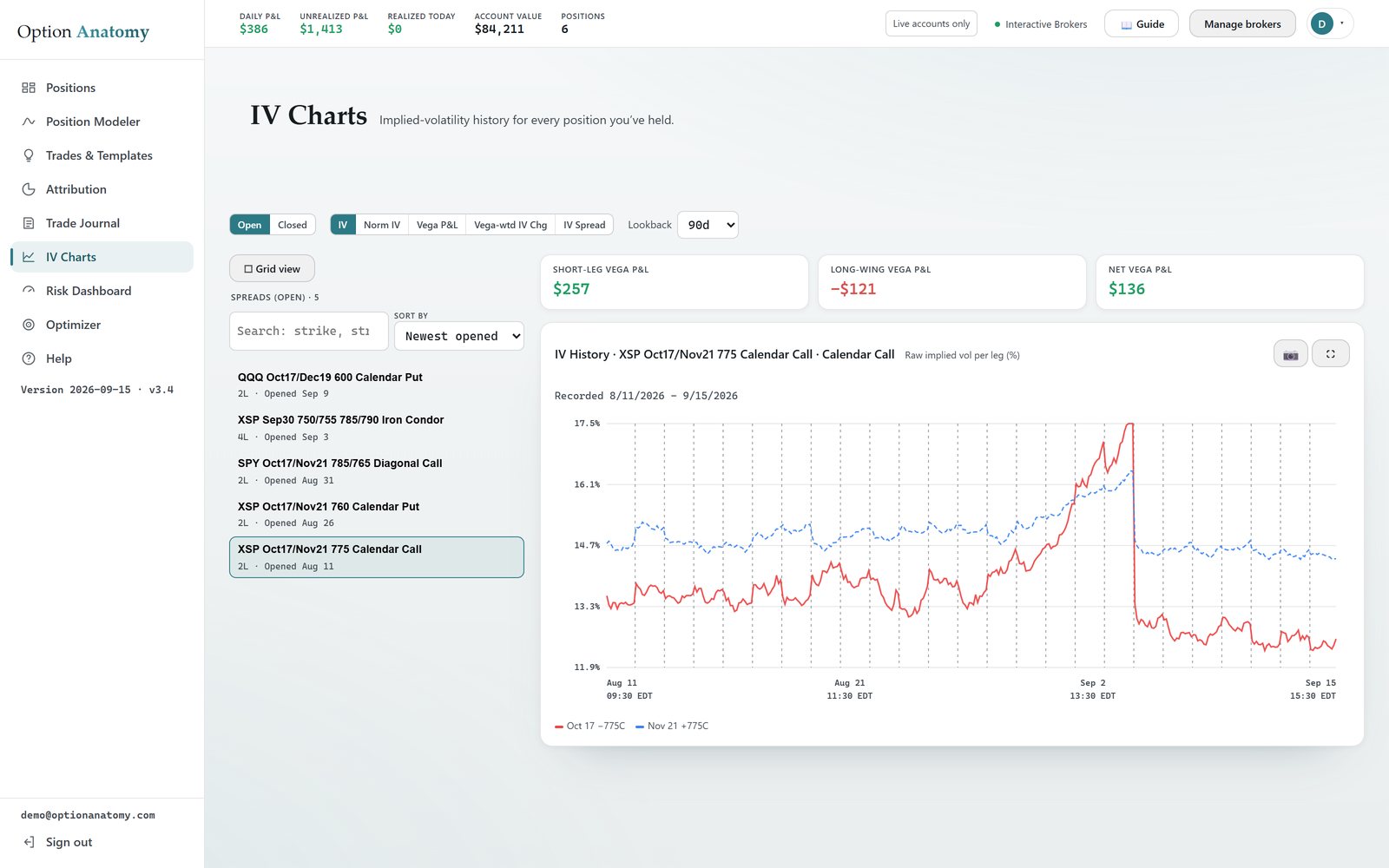
Weighted the way vega feels it.
An unweighted average implied volatility across a multi-leg position is close to meaningless: two points on a leg with large vega and two points on a leg with small vega are not the same event. The vega-weighted IV change signs and weights each leg by its own vega, so the line crosses zero where your vega P&L does.
Realized volatility over a maturity-matched window is charted next to implied, with the ratio between them. Rich or cheap stops being a feeling and becomes a number you can read before you add.
Figure: Implied volatility inflates into a scheduled event and collapses across it, with the underlying barely moving. The position feels it entirely through vega.
Five views of the same history.
One chart cannot answer every volatility question, so the same captured history renders five ways. Raw IV per leg shows the level. Norm IV rebases each leg to its own open, which is what you want when legs started at different volatilities and you care about who moved, not who was higher. Vega P&L converts the move into cumulative dollars. Vega-weighted IV change is the signed, vega-weighted average that crosses zero exactly at your vega-P&L breakeven. IV spread is back minus front, the number a calendar actually trades.
Switching between them costs a click and no reload, because they are five renderings of one captured series rather than five separate requests.
Closed positions keep their history.
A volatility chart that only covers open positions can tell you what is happening but never what happened. Scope the list to Closed and a finished structure still carries the implied-volatility history captured across its whole life, so you can go back and see what vol did between your entry and your exit.
That is the difference between a live monitor and a record you can learn from: the question "was I right about volatility on that trade" is only answerable after the trade is gone.
Which legs the volatility move paid.
Vega P&L is split rather than netted: short-leg vega P&L, long-wing vega P&L, and the net of the two. That split is the difference between a structure whose engine is working and one whose hedges are quietly consuming the engine's output.
Sort and filter across positions to compare them, or narrow to a single structure and watch its volatility history from the day it was opened.
Where does the implied volatility come from?
From the app's own market-data feed and pricing engine, computed consistently for every position on every broker rather than trusting whatever number each brokerage publishes. That consistency is what makes two positions at two different brokers comparable at all.
What is vega-weighted IV change?
The signed, vega-weighted average of each leg's implied volatility change. Because it weights by vega, it crosses zero at your vega P&L breakeven rather than wherever the raw average happens to be flat, which is the point a multi-leg position actually cares about.
Does it cover closed positions?
Yes. A closed structure keeps the volatility history captured while you held it, so you can look back at what implied volatility did across the life of a trade rather than only while it is open.