Options Strategy Optimizer
You have a view. The optimizer turns it into a ranked list of structures that express it, scored on probability of profit, return on risk, and what each one is actually worth if you turn out to be right.
State the view, not the structure.
Most tools make you pick a strategy first and find out afterwards whether it suited your thesis. The optimizer inverts that. Give it an underlying, a price target, a target date and, if you want one, a cap on what you are willing to risk, and it searches structures against those constraints instead of asking you to guess which one fits.
The target is a view, not a prediction you have to defend. Raise it, lower it, move the date, and watch the ranking reorder. That reordering is itself informative: a view that only pays through one exotic structure is usually a view the market has already priced.
Ranked on what matters, not on premium.
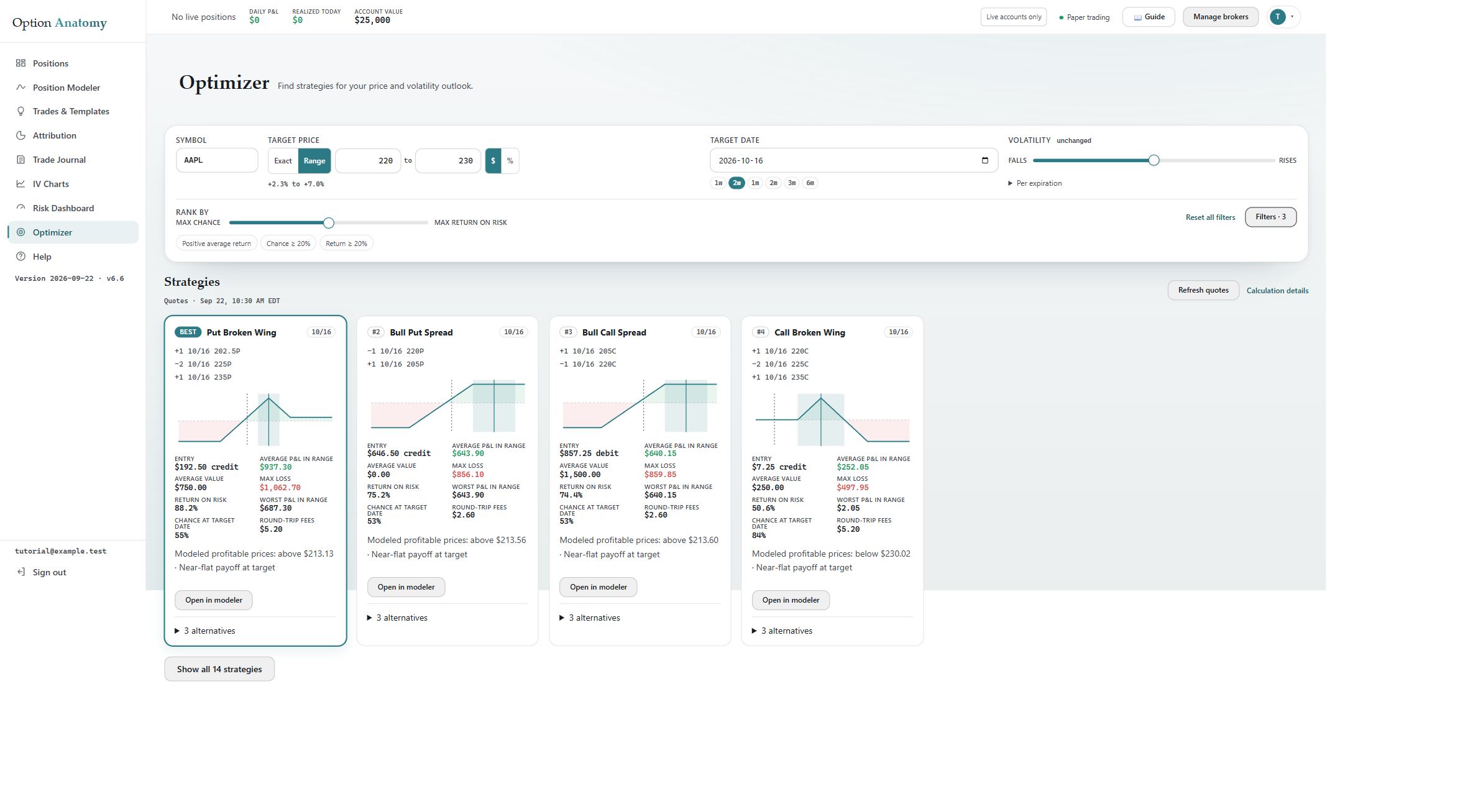
Compare the best quoted candidate from each strategy family, then expand its alternatives. Cards show modeled probability of profit at the target date, return on risk, scenario profit or loss and the risk basis. Ranking on premium collected alone is how traders end up selling precisely the structures that pay the most because they are the most likely to hurt.
Filters start with a 20% minimum chance and 20% minimum return on risk, which you can change. Set a maximum risk cap or filter strategy expirations. Defined-risk spreads show maximum loss; calendars and diagonals show estimated risk, which is not a guaranteed maximum loss. You can exclude those estimated-risk structures. Reset all filters restores the defaults and centers the ranking slider.
Figure: Probability of profit comes from the distribution the market is currently pricing, which widens with time. It is the best available estimate, and still an estimate.
Test the view, not just state it.
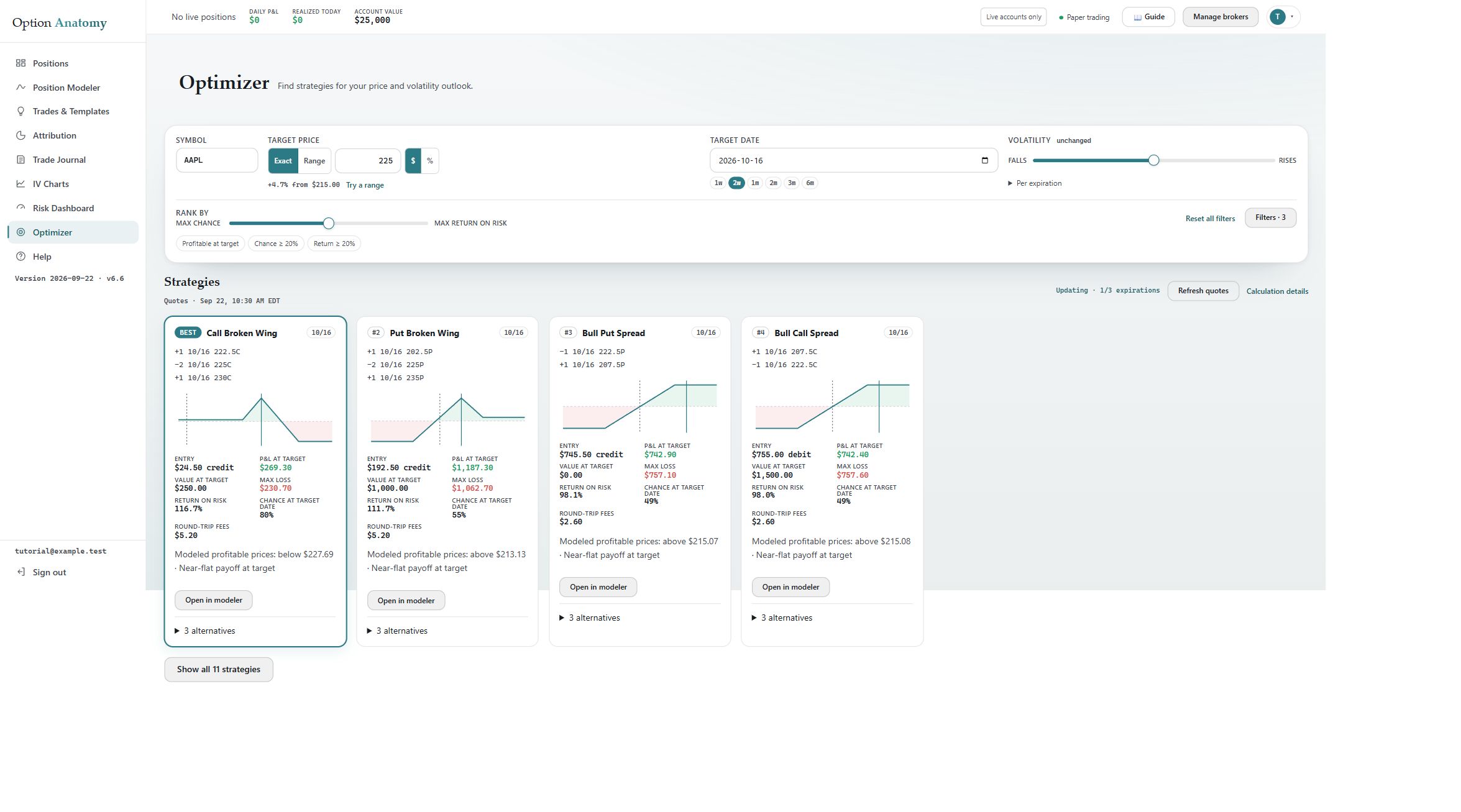
A price target is a guess, so the inputs are built to be moved. Type a level or a percentage move, switch from an exact price to a range, and the ranking reorders as you go, with no button to press and nothing to resubmit. In range mode, return on risk uses the average modeled outcome across the range; the worst modeled result within it is shown separately. Neither number tells you how likely the range itself is.
Target date is when the outlook is evaluated; Strategy expiration in Filters restricts when the contracts expire. Two more dials shape the answer. The priority slider runs from maximum chance to maximum return and is a degree, not a switch: the left end orders by probability of profit, the right end by return on risk, and everything between blends the two. And each expiration carries its own volatility target, so you can ask what a structure is worth if implied volatility lifts into your date and what it is worth if it bleeds out. A structure that only ranks well on frozen vol is one that depends on volatility standing still.
Straight into the modeler.
A ranking is a starting point, not an answer. Any candidate opens directly in the Position Modeler, where you can drag its strikes, slice it by date, stress it against a volatility shift, and see it merged with the book you already hold before committing anything.
Nothing here places an order. The optimizer proposes, the modeler tests, and the decision stays yours.
Does it tell me what to trade?
No, and it is not investment advice. It ranks structures against constraints you supply, which is arithmetic rather than a recommendation. The view is yours, the risk limit is yours, and so is the decision.
How is probability of profit calculated?
Chance is the modeled probability of profit at the target date under the market-implied distribution, in both exact and range modes. It is not the probability conditional on landing inside your target range and is not a guarantee. The quote timestamp and Calculation details explain the inputs and entry assumptions.
Can I compare against something I already hold?
Yes. Open a candidate in the modeler and load your held positions alongside it: the payoff curve then shows the merged book rather than the structure in isolation, which is what you would actually be holding.