Options Portfolio Risk Dashboard
Your whole options book as one risk surface: net greeks by strike and by expiry, value at risk on your own positions, and hedge bands that tell you when the book has actually drifted rather than when the clock says to look.
Net greeks, and where they come from.
A book-level delta is a summary that can hide its own composition: two large opposing exposures net to a comfortable number right up until one of them moves. The dashboard reports net Delta, Gamma, Theta and Vega across every connected account, then breaks each one down by strike and by expiry, so you can see whether your net is genuinely small or merely cancelling.
The by-expiry view is the one that catches calendar risk. A book that reads flat overall can be long the front and short the back, which is not a flat book at all. It is a term-structure position, and it will announce itself the first time the curve bends.
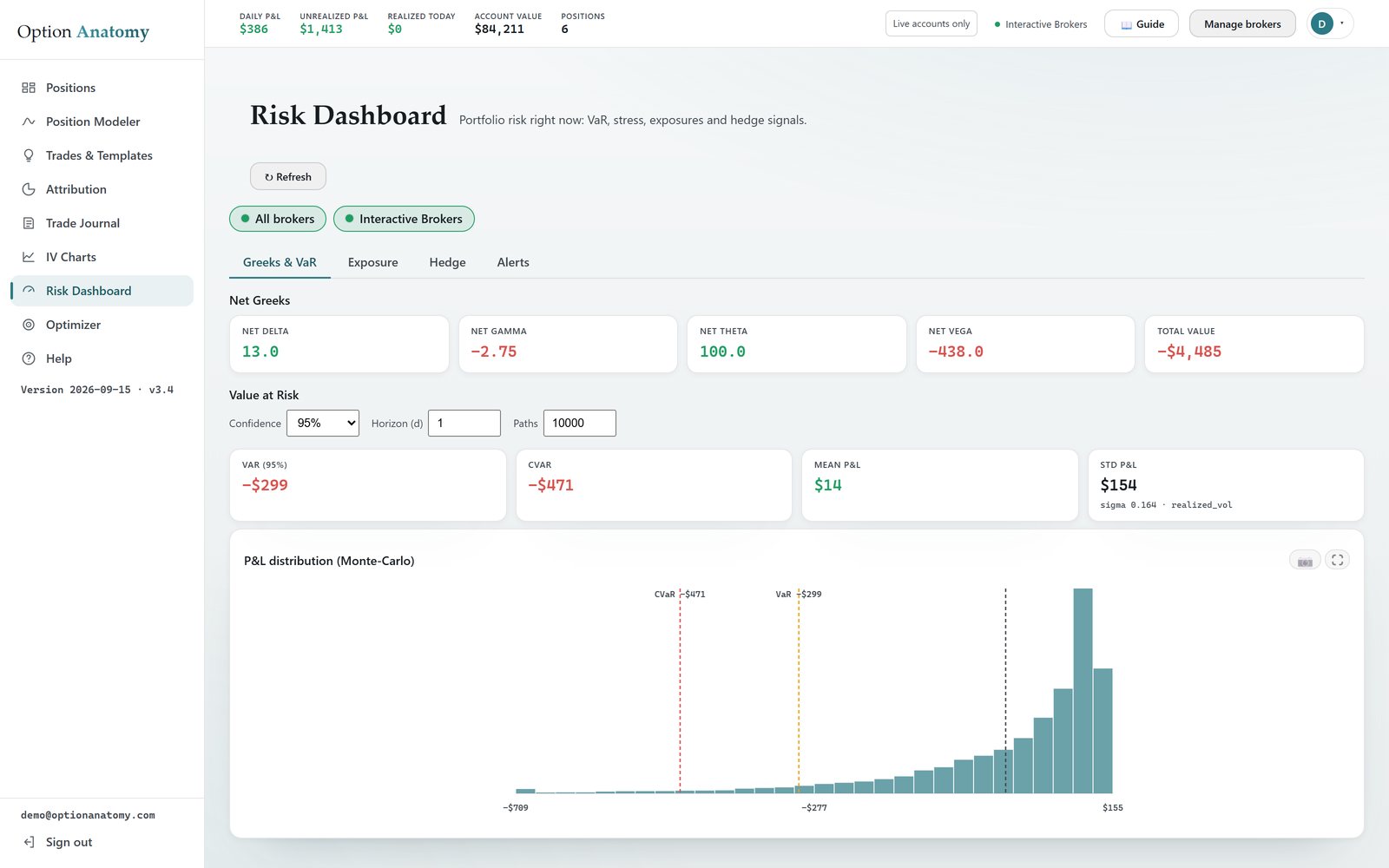
Value at risk, on your distribution.
VaR and CVaR are computed by Monte Carlo over a lookback window you choose, at a confidence level you choose. VaR answers how bad a normal bad day is. CVaR answers how bad the days beyond it average out to be, which is the number that matters when you are short premium and the tail is the entire risk.
Both are stated in dollars against your actual positions rather than as an abstract percentage, and both move as the book moves, so the figure on screen belongs to the book you are holding right now.
Hedge bands, not hedge habits.
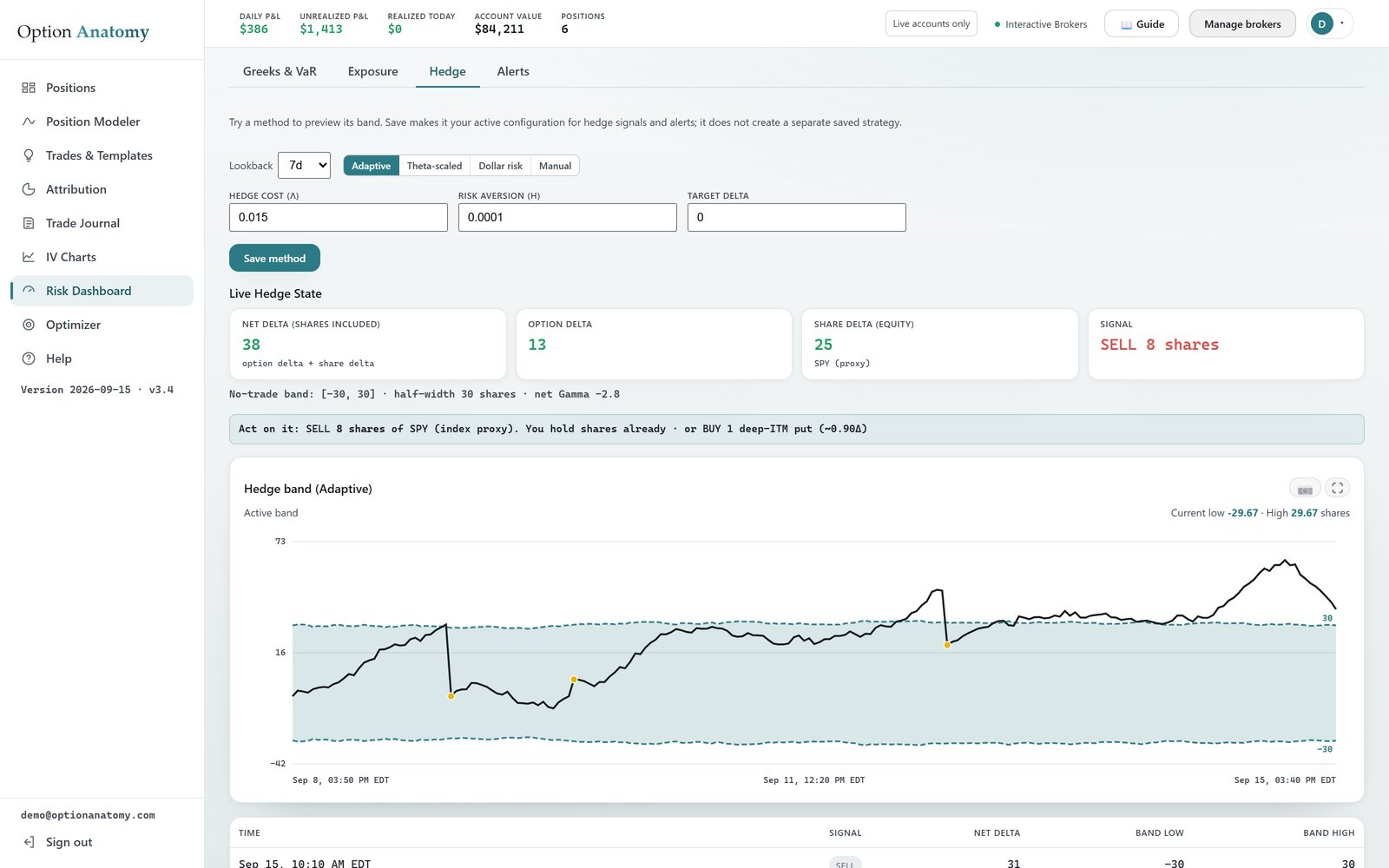
Delta hedging on a schedule pays commission for the privilege of being wrong on a timetable. The dashboard computes adaptive, cost-aware hedge bands from your position and its volatility, then shows live hedge state against them: net delta inside the band means do nothing, and the first touch of an edge is the signal.
Band low, band high and current net delta sit on screen together, so the decision is visible rather than remembered. That is the difference between hedging twice a day out of anxiety and hedging three times a week because the position asked.
Alerts that reach you.
Greek-ratio alerts watch the relationships that change a book's character, and fire when one crosses a threshold you set. Delivery goes to Telegram, so it arrives where you are rather than in a dashboard you have to remember to open.
Thresholds, the cooldown between repeats, and whether alerts evaluate outside regular trading hours are all yours to set. Overnight greek drift against a synthetic spot is rarely something you can act on, so you can choose not to hear about it.
What is a hedge band?
A no-trade zone around delta-neutral. Inside it, the cost of rebalancing exceeds the risk being carried, so the position is left alone; at its edge, the risk is worth the commission and the spread. The width comes from the Adaptive (cost-aware) method, which accounts for your volatility and transaction costs rather than picking a round number.
How is VaR calculated?
Monte Carlo simulation over a historical lookback you select, at a confidence level you select, applied to your actual positions. CVaR is reported beside it: the average loss in the tail beyond VaR, which is the more honest figure for short-premium books.
Do alerts work when I am not signed in?
Yes. Alert evaluation runs against your connected positions and delivers to Telegram, so it does not depend on a browser tab staying open.